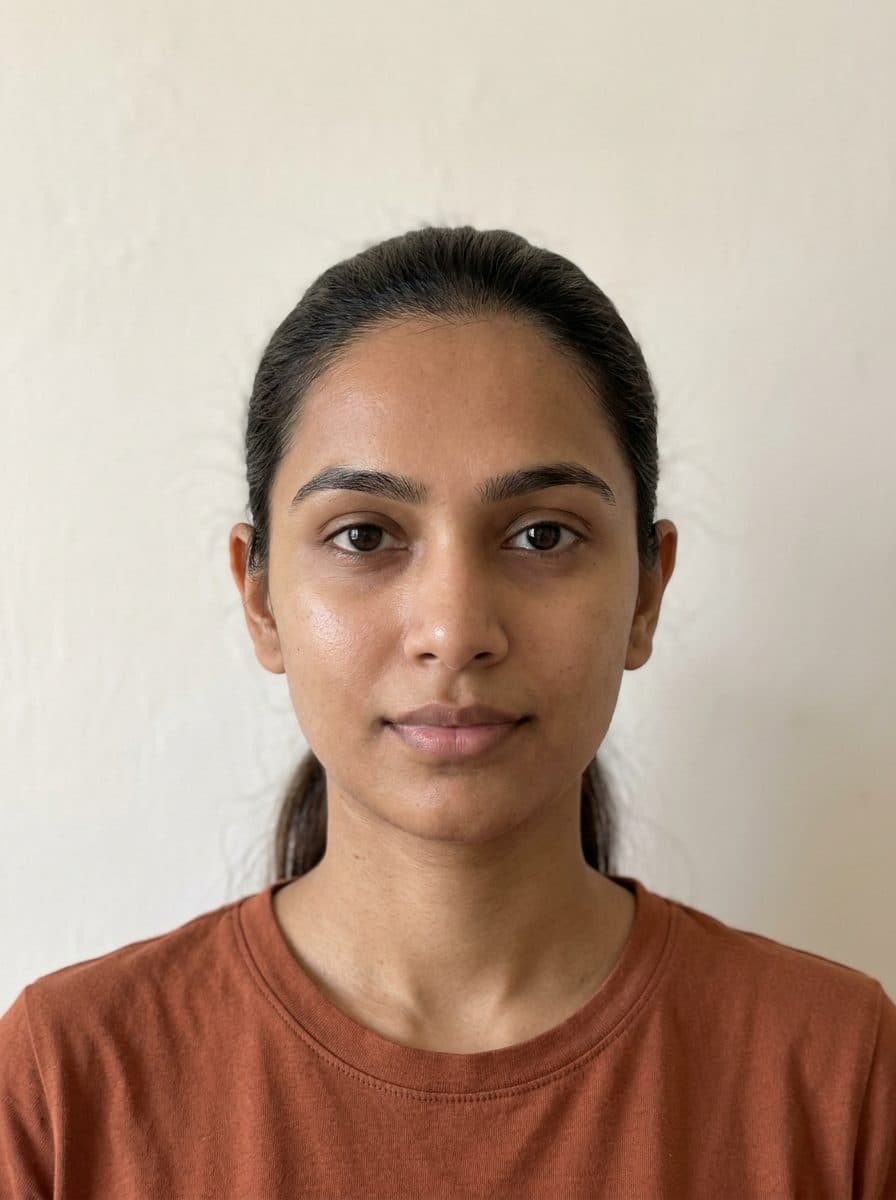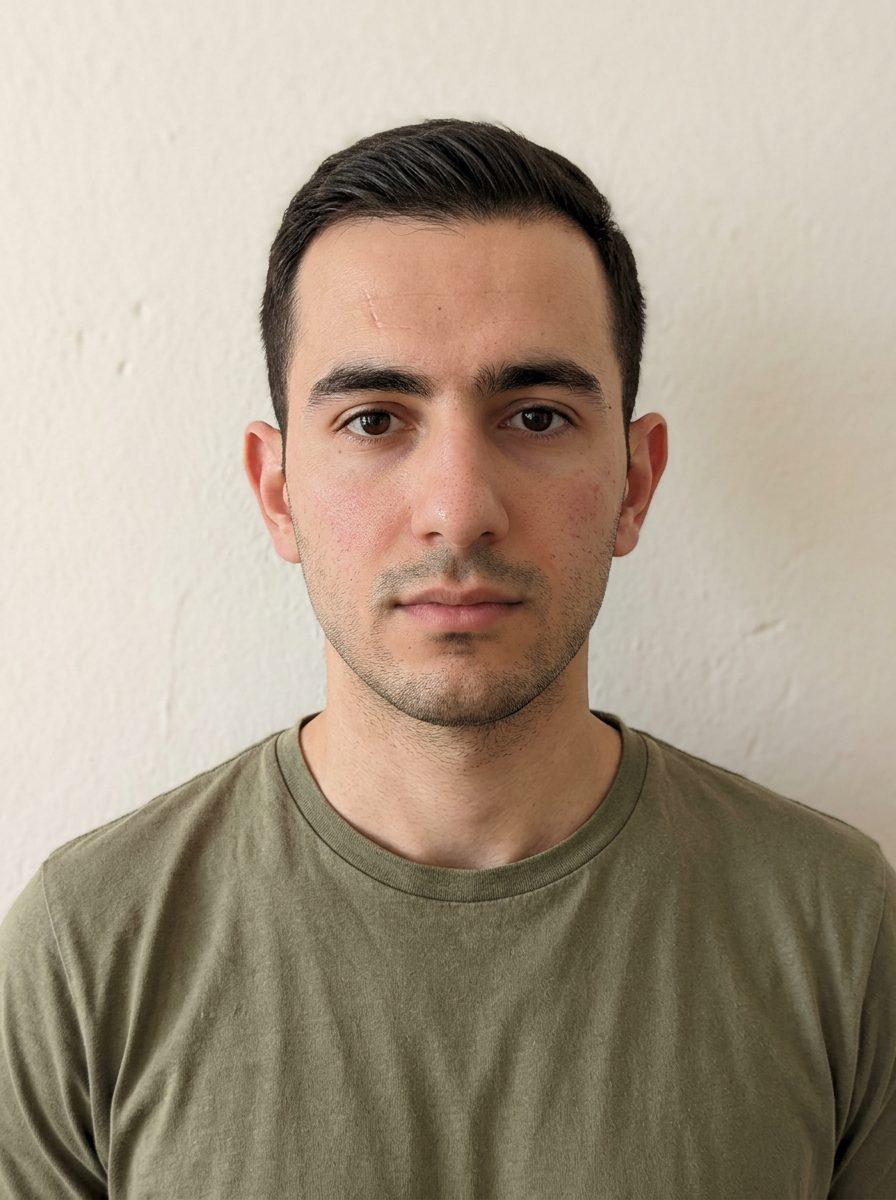
What are facial thirds and fifths?
Facial thirds divide the face into three sections from top to bottom: hairline to brows, brows to the base of the nose, and the base of the nose to the chin. Facial fifths divide the face into five sections at eye level: the space beside one eye, that eye, the gap between the eyes, the other eye, and the space beside it.
In classical drawing proportions, the three sections are equal in height, and each of the five sections is one eye wide. The idea of equal thirds goes back at least to the Roman architect Vitruvius (De Architectura 3.1.2). Researchers study versions of these rules as the neoclassical canons.
This calculator shows how those sections measure up in your photo, including where your lips divide the lower third. It uses Google’s MediaPipe Face Landmarker to find the measurement points. The results describe your proportions without assigning a beauty score.
How to get more consistent measurements
- Hold the camera at eye level. Tilting your chin up or down changes the apparent height of each section.
- Face the camera straight on, look into the lens, and keep your head level.
- Relax your face and close your mouth. Smiling or opening your mouth changes the lower third.
- Keep the camera at least an arm’s length away, or ask someone else to take the photo. Close-up selfies distort proportions.
- Pull your hair back so your forehead, brows, and the sides of your face are visible.
- Use soft, even lighting that keeps your whole face clearly visible.
Before reading the numbers, check that the dots line up with your brows, the base of your nose, your chin, and the corners of your eyes.
Reading your results
The main ratio is the height of your middle third divided by the height of your lower third. At 1.00, they’re equal. Above 1.00, the middle third is longer; below 1.00, the lower third is longer. We label them “about equal” when the ratio is within 5% of 1.00. That range is a labeling choice, not a medical threshold.
Your thirds and fifths shows the measurement lines on your photo: gold for thirds and blue for fifths. You can download the image as a PNG.
Your facial thirds lists the height of each section in millimeters. The upper third is marked partial because the tool can’t locate your hairline (see why only part of the upper third is measured). Millimeter estimates assume an iris diameter of 11.7 mm.
Lower third: nose, lips, and chin shows how your lips divide the lower third. A ratio of 1 : 2.00 means the distance from your lips to your chin is twice the distance from the base of your nose to your lips. Both measurements use the point where your lips meet.
Your facial fifths lists the five sections from left to right in the photo. A value of 1.00 means a section is as wide as your average eye width. Values within 0.10 of 1.00 are labeled “about one eye wide.” Below those measurements, you’ll see the total width at eye level and the ratio of nose width to the gap between your eyes.
Ratios are shown to two decimal places, but those extra digits don’t indicate measurement accuracy. See the limitations before interpreting small differences.
How the thirds are measured
The tool finds 478 facial landmarks and adjusts for sideways head tilt so the line between your eyes is level. It measures the vertical distances between four points:
| Boundary | Classical point | What this tool uses |
|---|---|---|
| Top of the upper third | Hairline (trichion) | Highest detected forehead point (landmark 10) |
| Upper / middle | Between the brows (glabella) or the bridge of the nose (nasion) | Between the brows (landmark 9) |
| Middle / lower | Base of the nose (subnasale) | Base of the nose (landmark 2) |
| Bottom of the lower third | Bottom of the chin (menton) | Bottom of the chin (landmark 152) |
Studies don’t all measure from the same point near the brows. Some use the point between them, as this tool does (Milutinovic et al., 2014); many use the bridge of the nose, which is lower. Starting between the brows gives a longer middle third, so the ratios aren’t directly comparable.
In the example above, the middle third is about 63 mm and the lower third is about 60 mm. Dividing one by the other gives a ratio of 1.06.
Why only part of the upper third is measured
The highest point the model detects, landmark 10, sits on the forehead, usually well below the hairline. The measurement starts there, leaving out the area between that point and your hairline.
That’s why the main result compares the middle and lower thirds. Both have endpoints the model can locate. The partial upper-third value tells you the height of the detected section; it doesn’t give your full forehead height.
Your lower third: nose, lips, and chin
The point where your lips meet, called the stomion, divides the lower third into two parts. Classical descriptions place it one-third of the way down: one part from the base of the nose to the lips, and two parts from the lips to the chin (Milutinovic et al., 2014). A study comparing faces ranked as attractive with classical sculptures suggested a slightly different split of about 30% and 70% (Mommaerts & Moerenhout, 2011).
In this example, the split is 1 : 2.04, with about 20 mm from nose to lips and 40 mm from lips to chin. Keep your lips closed and relaxed for this measurement; even a slight smile or parted lips can move the dividing point.
How the fifths are measured
The tool places six vertical lines across the face: one at each side of the face near the cheekbones, and one at each inner and outer eye corner. The spaces between them form the five sections. Each width is divided by your average eye width, measured corner to corner. In the classical proportions, each section is 1.00 eye width, for a total of 5.00.
From left to right in the photo, the sections measure 0.86, 1.00, 1.18, 1.00, and 0.83 eye widths, for a total of 4.87. The two eye measurements always average 1.00 because their average width defines the unit.
The classical rules also put the gap between the eyes (intercanthal width) at one eye width and the nose width at the same width as that gap. Your results include the gap measurement and the nose-to-gap ratio.
Do real faces have equal thirds and fifths?
Often, they don’t. Studies comparing facial measurements with the classical rules have found several common differences:
- The three sections are rarely equal in height. A study of 153 young white North American adults found that the classical rules didn’t represent average facial proportions (Farkas et al., 1985). A comparison of Chinese, Vietnamese, Thai, and white North American adults also found unequal thirds in all four groups (Le et al., 2002).
- The lower third is often longer than the middle third. This was the case for roughly nine in ten participants in a study of young adults from the Arabian Peninsula (Al-Sebaei, 2015). It was also common in a study of 103 Southern Chinese adults (Jayaratne et al., 2012).
- The gap between the eyes can be wider than one eye. In the Southern Chinese study, that was true for every participant (Jayaratne et al., 2012).
- Nose width doesn’t always match the gap between the eyes. The two matched in 40% of the 1985 North American sample. In the Arabian Peninsula study, when they differed, the nose was usually wider (Al-Sebaei, 2015). A larger international study also found differences in nose width across population groups (Farkas et al., 2005).
A review of data from 27 articles found that no ethnic or gender group consistently matched the classical ideals (Khoshab et al., 2022). These studies used calipers or 3D cameras and their own measurement points, so their numbers aren’t directly comparable with this calculator’s results.
Do facial thirds affect attractiveness?
Research offers limited evidence about a link between equal thirds and attractiveness. One study compared 24 female celebrities selected from magazine rankings with 83 female students. It found statistically significant differences between the students’ three facial sections, but not between the celebrities’ sections; the fifths showed a similar pattern (Milutinovic et al., 2014). The study didn’t collect attractiveness ratings, and all participants were white women. It can’t establish that equal thirds make a face more attractive.
Other experiments have tested how changing facial proportions affects ratings. Pallett and colleagues edited photos to change eye-to-mouth distance or the spacing between the eyes. Participants preferred an eye-to-mouth distance of about 36% of face length and a distance between pupils of about 46% of face width (Pallett et al., 2010). Those photos also showed only white women, and the authors cautioned that the findings may not apply more broadly. These measurements don’t directly test the rule of equal thirds.
Our separate AI attractiveness test includes thirds and fifths in its harmony score. That page explains the reference values and weights we chose for the score.
Why your results change between photos
- Head tilt. Tilting your chin changes how tall each section looks in a photo. Chin down tends to shorten the lower third; chin up tends to lengthen it. A study that photographed faces at different angles found changes even between 2° steps (Okuda et al., 2000).
- Camera distance. A camera close to your face makes features near the lens, such as your nose, look larger relative to the sides of your face.
- Expression. Smiling widens the mouth and lifts the cheeks. Parted lips can lengthen the lower third.
- Hair and beards. Hair can obscure the edges of your face, and a beard can hide the outline of your chin. Both can affect where the tool places its points.
- Mirrored selfies. Mirroring reverses the left and right labels without changing the proportions.
Limitations
- Accuracy hasn’t been independently established. We haven’t validated this tool against measurements taken by a clinician. Small differences between photos may reflect measurement variation.
- Detected points may be misplaced. They may not match the points a researcher would mark by hand. An earlier, 468-point version of the model had an average landmark error of 3.96% of the distance between the eyes (Kartynnik et al., 2019). That figure doesn’t tell us the accuracy of this tool’s ratios.
- Some boundaries are approximate or incomplete. The upper third stops below the hairline. The outer fifths end at detected points near the cheekbones, excluding the ears and hair.
- Millimeters use an assumed iris size. They’re estimates rather than measurements calibrated to your face.
- A photo can distort proportions. The tool corrects sideways tilt, but it can’t fully correct for a raised or lowered chin, a turned head, or lens distortion.
- This isn’t a medical or orthodontic assessment. It can’t tell you whether a treatment or procedure is appropriate.
Sources
Guide maintained by Your Face Report. Last updated November 11, 2026.
- Vitruvius. The ten books on architecture (M. H. Morgan, Trans.; 1914). Book III, chapter 1, section 2. Project Gutenberg.
- Farkas, L. G., Hreczko, T. A., Kolar, J. C., & Munro, I. R. (1985). Vertical and horizontal proportions of the face in young adult North American Caucasians: Revision of neoclassical canons. Plastic and Reconstructive Surgery, 75(3), 328–338.
- Le, T. T., Farkas, L. G., Ngim, R. C., Levin, L. S., & Forrest, C. R. (2002). Proportionality in Asian and North American Caucasian faces using neoclassical facial canons as criteria. Aesthetic Plastic Surgery, 26(1), 64–69.
- Farkas, L. G., Katic, M. J., Forrest, C. R., et al. (2005). International anthropometric study of facial morphology in various ethnic groups/races. Journal of Craniofacial Surgery, 16(4), 615–646.
- Jayaratne, Y. S. N., Deutsch, C. K., McGrath, C. P. J., & Zwahlen, R. A. (2012). Are neoclassical canons valid for Southern Chinese faces? PLoS ONE, 7(12), e52593.
- Al-Sebaei, M. O. (2015). The validity of three neo-classical facial canons in young adults originating from the Arabian Peninsula. Head & Face Medicine, 11, 4.
- Khoshab, N., Donnelly, M. R., Sayadi, L. R., Vyas, R. M., & Banyard, D. A. (2022). Historical tools of anthropometric facial assessment: A systematic raw data analysis on the applicability of the neoclassical canons and golden ratio. Aesthetic Surgery Journal, 42(1), NP1–NP10.
- Milutinovic, J., Zelic, K., & Nedeljkovic, N. (2014). Evaluation of facial beauty using anthropometric proportions. The Scientific World Journal, 2014, 428250.
- Mommaerts, M. Y., & Moerenhout, B. A. (2011). Ideal proportions in full face front view, contemporary versus antique. Journal of Cranio-Maxillofacial Surgery, 39(2), 107–110.
- Pallett, P. M., Link, S., & Lee, K. (2010). New “golden” ratios for facial beauty. Vision Research, 50(2), 149–154.
- Okuda, S., Yamagata, S., Yamamoto, T., Imai, T., & Iida, J. (2000). An analytical study on the acceptable range of pitching angle for proper frontal facial photo. Journal of Hokkaido Orthodontic Society, 28(1), 35–41.
- Kartynnik, Y., Ablavatski, A., Grishchenko, I., & Grundmann, M. (2019). Real-time facial surface geometry from monocular video on mobile GPUs. arXiv:1907.06724.
- Google AI Edge. Face landmark detection guide. Documentation for the 478-landmark model used by this tool.