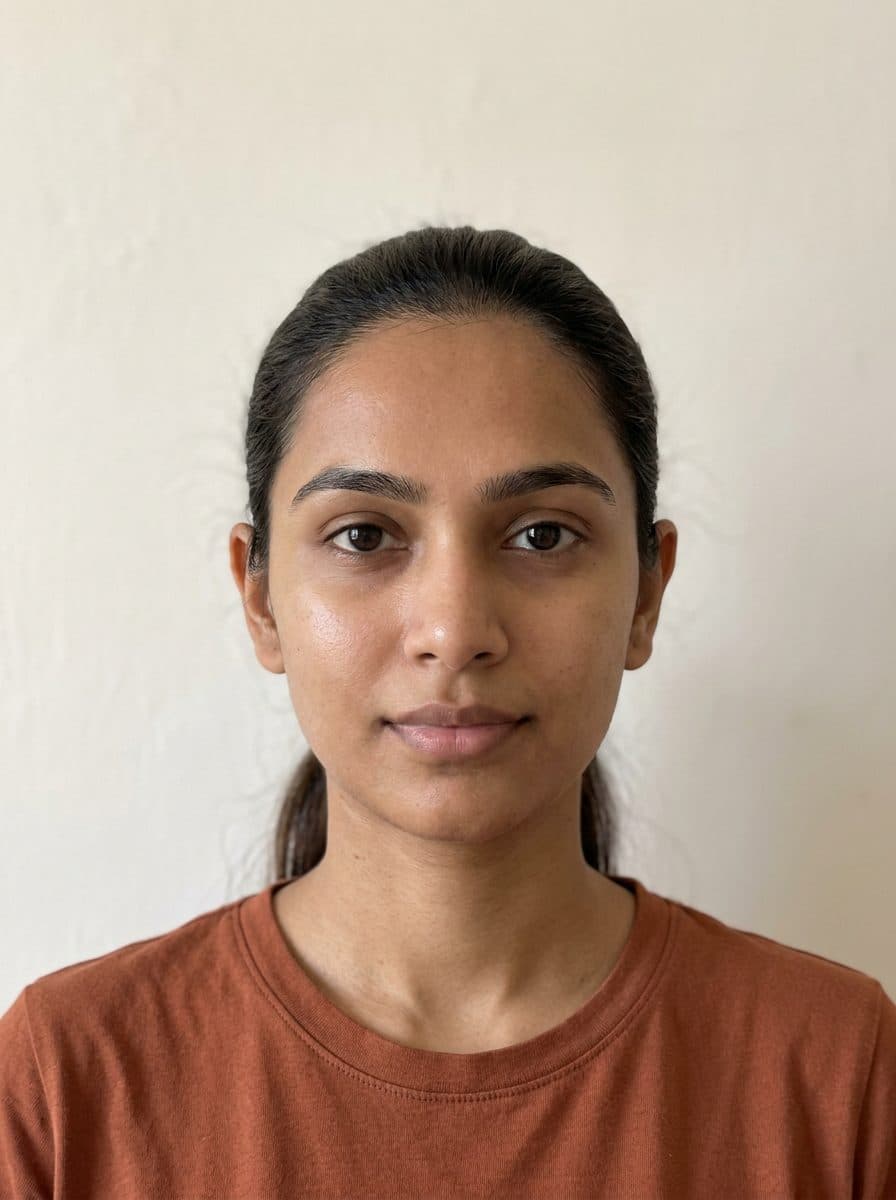
What a face symmetry test measures
A face symmetry test compares the size and position of matching features on the left and right sides of your face, such as your eyes, brows, and mouth corners.
This tool uses a single front-facing photo. It finds 478 facial landmarks with Google’s MediaPipe Face Landmarker, estimates a midline down the center of your face, and compares 21 pairs of matching points across it. You get:
- A symmetry score from 0 to 100, based on how closely matching points line up when mirrored, with equal weight given to each region.
- A score for each region: eyes, brows, nose and mouth, and the outline of the face.
- Left and right compared: differences in brow height, eye opening and width, nose tip and chin position, mouth corners, and half-face width, expressed as estimated millimeters or percentages.
- Mirror images: each half of your face joined to its own reflection, alongside your original face with the midline upright.
It measures shape and position in one photo. The score does not assess skin texture or color, measure depth, or capture how your face moves. It also cannot tell a lasting difference from one caused by your head position.
How the symmetry score works
Leveling the photo
We rotate the landmark coordinates to make your eye line horizontal before comparing the two sides. This corrects sideways tilt in the image. It cannot undo the perspective changes caused by turning your head or looking up or down. The photo check asks you to retake the photo if your head is turned too far.
Fitting the midline
We estimate the midline from 21 landmarks running from your forehead through your nose and lips to your chin. The fitted line takes all these points into account, rather than using the nose or chin alone. If those features sit off-center, they can still shift the line.
You can see the fitted midline on your photo, where it divides the two halves used for the mirror images. Brow and mouth-corner heights are compared vertically after leveling your eye line.
Mirroring matched points
The 21 pairs are grouped into four regions:
- Eyes: both corners, the top and bottom of the lid opening, and the center of the iris.
- Brows: the inner end, the peak and the outer end.
- Nose and mouth: the sides of the nostrils, the cheek below each eye and the mouth corners.
- Face outline: ten pairs of points along the sides of the face, from the temples to the jaw and chin.
For each pair, we reflect one point across the midline and measure its distance from the point on the other side. If the landmarks were perfectly symmetrical, every reflected point would land on its partner.
- Landmark
- Mirrored from the other side
- Fitted midline
From offset to score
We divide each mirror offset by the distance between your pupils to account for image scale. Camera distance and head position can still affect the result. We then average the offsets within each region and average the four regional values. This gives each region equal weight, even though the outline has ten pairs and the brows have three.
The score decreases as the average offset grows. Scores are rounded to whole numbers, so a displayed 100 can still include small differences. There is no pass mark:
| Average offset (share of pupil distance) | Score |
|---|---|
| 0.5% | 97 |
| 1% | 94 |
| 2% | 88 |
| 3% | 82 |
| 5% | 72 |
| 10% | 51 |
| 15% | 37 |
An offset of 15% of your pupil distance gives a score of about 37. This scale is a setting of the tool, not a reference range derived from population data. We do not collect free results to build a population ranking. Our AI attractiveness test uses the same symmetry calculation, so both tools give the same symmetry score for the same photo.
Reading your results
The overall score summarizes the four regions. Your eyes might line up closely while your jawline differs more from side to side. A single score can hide these regional differences. Below the score, you’ll see the average mirror offset in estimated millimeters and as a percentage of your pupil distance.
Left and right compared shows where the measured differences are:
- Brow height: the vertical difference between the peaks of your brows.
- Eye opening and eye width: how far each eye opens from lid to lid, and how wide it is from corner to corner, as a percentage difference.
- Nose tip and chin: how far each sits from the midline, and toward which side.
- Mouth corners: the vertical difference between the corners of your mouth.
- Half-face width: the distance from the midline to the widest point of each cheek, as a percentage difference.
Percentage differences use the average of the two sides as their reference. For example, widths of 10 and 12 have an 18.2% difference on this scale: the difference of 2 is divided by their average of 11. The result also names the wider or more open side.
Differences below 0.5 mm, or below 2% for widths and openings, are shown as even to avoid emphasizing tiny estimates. These cutoffs do not mean the tool is accurate to 0.5 mm or 2%. Actual accuracy depends on the photo and landmark placement.
Left and right refer to your own sides. In an unmirrored photo, your right appears on the left of the image, which is why the right + right composite sits on the left. Some phones save mirrored selfies; if yours does, the labels in the result are swapped.
Millimeter estimates assume an iris diameter of 11.7 mm, a reference used in Google’s MediaPipe Iris work. Actual iris size varies, so these values are approximate. The percentages and symmetry score do not depend on this assumed diameter.
What the mirror images show
Each composite joins half of your face to its reflection along the fitted midline. Right + right uses your right half; left + left uses your left half. Researchers use similar images, called chimeric faces, to study facial expression. In Sackeim, Gur, and Saucy’s 1978 study, observers judged expressions in left-side composites as more intense than those in right-side composites.
When comparing your mirror images:
- They may look unfamiliar. Each one repeats a single side instead of showing your whole face as it appears in the original photo.
- Familiarity matters. You may be more used to your reflection than to an unmirrored photo. In Mita, Dermer, and Knight’s 1977 studies, participants preferred their mirror-reversed photos, while friends or partners tended to prefer the unreversed ones. This may help explain why the “as photographed” panel looks unfamiliar to you.
- Small errors can stand out. If the midline is slightly off-center, one composite becomes wider and the other narrower. A head turn can have a similar effect, and hair or shadows on one side are repeated on the other.
Use the composites to explore the differences between the two sides. They are edited images, not predictions of how a change to your face would look.
Is a symmetrical face more attractive?
Research has found a link between facial symmetry and attractiveness, but symmetry is only one part of the picture. Rhodes’s 2006 review identified symmetry and averageness among the features associated with attractiveness. These findings do not establish an attractiveness scale for this tool.
The way researchers create symmetrical images matters. Rhodes and colleagues (1998) found a preference for more symmetrical versions, while Swaddle and Cuthill (1995) found that their more symmetrical versions were rated less attractive. Perrett and colleagues (1999) showed that changing facial shape while preserving skin texture produced a preference for greater symmetry. Their work also discussed how image-editing artifacts could affect earlier results.
A higher score here means the matching landmarks line up more closely in this photo. It does not tell you how attractive you are or whether anything needs changing. To explore symmetry alongside other facial proportions, try the attractiveness test, which uses it as one of five components.
Why no face is perfectly symmetrical
Small left–right differences are part of normal human variation. In biology, small random departures from symmetry are called fluctuating asymmetry, a concept discussed by Van Valen (1962). These differ from patterns that consistently favor one side across a population. A photo test cannot tell you what caused a particular difference.
A photo adds differences of its own: a small head turn, uneven light, hair over one side, or a slight smile. That is why your score can change between photos taken minutes apart. Compare photos taken under similar conditions before drawing conclusions from a change in score.
Limitations
- One flat photo. The score uses two-dimensional landmark positions. It cannot measure how far features project from the face, and a turned head can look like asymmetry.
- Landmarks are estimates. The model estimates points from the photo. Hair, shadows, or a beard can affect their placement, and small differences may be missed.
- The midline is fitted, not anatomical. It is estimated from landmarks down the center of the face. An off-center nose or chin can shift it.
- Millimeters come from the iris. They depend on the assumed iris diameter and how accurately its edges are detected.
- Not a medical assessment. The tool can’t diagnose anything, and its results shouldn’t be used to plan treatment.
When asymmetry is a medical question
Small differences between the two sides of a face are common. Sudden changes need attention. If one side of your face suddenly droops or becomes weak, call emergency services immediately, especially if you also have arm weakness or slurred speech. These can be signs of a stroke (NHS: stroke symptoms). Do not wait for a photo test. A new lump, swelling, or change in your bite is also worth discussing with a clinician.
How to get a fair measurement
To make results easier to compare, keep the photo conditions the same each time:
- Face the camera straight on, with your nose pointing at the lens and your head level.
- Avoid close-up selfies. Hold the camera at least an arm’s length away, or have someone take the photo from farther back while keeping your face clear. Research on camera distance shows that close-up photos can distort facial proportions.
- Use even light from in front of you, such as a window. Strong shadows on one side can affect landmark placement.
- Keep a neutral expression with your mouth closed. A smile can change the comparison between sides.
- Pull hair off your forehead and jaw, and remove glasses.
- Check whether your phone mirrors selfies if you want to compare sides between photos.
If two photos give different results, check head position, camera distance, lighting, and expression first. A change in score alone does not show that your face has changed.
Sources
- Grammer, K., & Thornhill, R. (1994). Human (Homo sapiens) facial attractiveness and sexual selection: The role of symmetry and averageness. Journal of Comparative Psychology, 108(3), 233–242.
- Rhodes, G., Proffitt, F., Grady, J. M., & Sumich, A. (1998). Facial symmetry and the perception of beauty. Psychonomic Bulletin & Review, 5(4), 659–669.
- Swaddle, J. P., & Cuthill, I. C. (1995). Asymmetry and human facial attractiveness: Symmetry may not always be beautiful. Proceedings of the Royal Society B, 261(1360), 111–116.
- Perrett, D. I., Burt, D. M., Penton-Voak, I. S., Lee, K. J., Rowland, D. A., & Edwards, R. (1999). Symmetry and human facial attractiveness. Evolution and Human Behavior, 20(5), 295–307.
- Rhodes, G. (2006). The evolutionary psychology of facial beauty. Annual Review of Psychology, 57, 199–226.
- Sackeim, H. A., Gur, R. C., & Saucy, M. C. (1978). Emotions are expressed more intensely on the left side of the face. Science, 202(4366), 434–436.
- Mita, T. H., Dermer, M., & Knight, J. (1977). Reversed facial images and the mere-exposure hypothesis. Journal of Personality and Social Psychology, 35(8), 597–601.
- Van Valen, L. (1962). A study of fluctuating asymmetry. Evolution, 16(2), 125–142.
- Kartynnik, Y., Ablavatski, A., Grishchenko, I., & Grundmann, M. (2019). Real-time facial surface geometry from monocular video on mobile GPUs. arXiv:1907.06724.
- Google AI Edge. Face landmark detection guide. Documentation for the 478-landmark model used by this tool.
- Google Research (2020). MediaPipe Iris: Real-time iris tracking & depth estimation. Background on the iris-diameter reference.
- Ward, B., Ward, M., Fried, O., & Paskhover, B. (2018). Nasal distortion in short-distance photographs: The selfie effect. JAMA Facial Plastic Surgery. doi:10.1001/jamafacial.2018.0009.